Not all Solana DEX pools behave the same. Here’s how to choose the best DEX for volume bots—fees, liquidity, volatility, and real setups.

You can run the cleanest volume strategy in the world… and still get wrecked by one boring decision:
Which DEX/pool you’re actually trading on.
On Solana, that choice changes everything—fees, slippage, how “real” your volume looks, how often you get sandwiched, and whether you can hold a chart together for more than 30 minutes.
I’ve seen teams spend $2,000 on “volume” and end up with a chart that looks like a seismograph. I’ve also seen a $150/day plan quietly climb ranks because the pool choice matched the token’s reality.
TL;DR (save this for later)
If you want the simplest, most widely compatible path: start with Raydium on a healthy pool.
If your token is volatile and you want tighter control of price movement: consider Orca Whirlpools or Meteora DLMM (concentrated liquidity).
If you want best execution across routes: use Jupiter routing as the engine—but remember it still trades through actual pools.
Before spending a dollar: check liquidity depth, fee tier, and expected slippage. Use the /calculator to budget realistically.
The DEX choice that decides your results

Here’s the mental model I use.
Think of your token’s pool like a highway.
- A wide, well-lit highway (deep liquidity) lets you drive smoothly at speed.
- A narrow mountain road (thin liquidity) makes every turn violent.
A volume bot is just your driving style. But the road determines whether you arrive looking professional… or upside-down in a ditch.
Why “volume” behaves differently across Solana DEXs
Even if two pools show the same 24h volume, the mechanics can be totally different:
- AMM type: standard constant-product vs concentrated liquidity vs dynamic liquidity.
- Fee tier: higher fees can discourage real flow, but can also “mask” micro-churn.
- Liquidity distribution: where liquidity sits matters more than the total number.
- MEV exposure: some environments attract more aggressive bots.
If you’re aiming for rank velocity (moving up lists) or chart stability (not nuking your own price), the pool choice is step one.
If you’re new to the space and want the bigger picture first, skim this primer: Complete Crypto Volume Bot Guide.
Raydium vs Orca vs Meteora (and where Jupiter fits)
Let’s make this simple and practical.
You’re usually deciding between:
- Raydium pools (classic, widely used)
- Orca Whirlpools (concentrated liquidity)
- Meteora DLMM (dynamic concentrated liquidity)
- Jupiter as a router (not a pool—an execution layer)
To anchor this in something real: if you’re trying to trend on DexScreener, you’re not just buying “volume.” You’re buying signals—trade consistency, wallet distribution, and believable flow.
For context, DexScreener itself is here: https://dexscreener.com/
Quick comparison (one table, no fluff)
| Venue | Best for | Strengths | Watch-outs | |---|---|---|---| | Raydium | Most token launches + broad compatibility | Familiar pools, easy routing, lots of eyes | Thin pools get choppy fast | | Orca Whirlpools | Controlling price impact with concentrated liquidity | Efficient liquidity near current price, good for stability | Needs active management; ranges can drift | | Meteora DLMM | Dynamic liquidity + smoother execution in volatile phases | Adaptive bins can reduce chaos | Bin placement matters; still not “set and forget” | | Jupiter (router) | Best execution across pools | Routes orders to reduce slippage | You still depend on underlying pools |
Now let’s break down when each one is the “right road.”
Raydium: the default choice (and why it often wins)
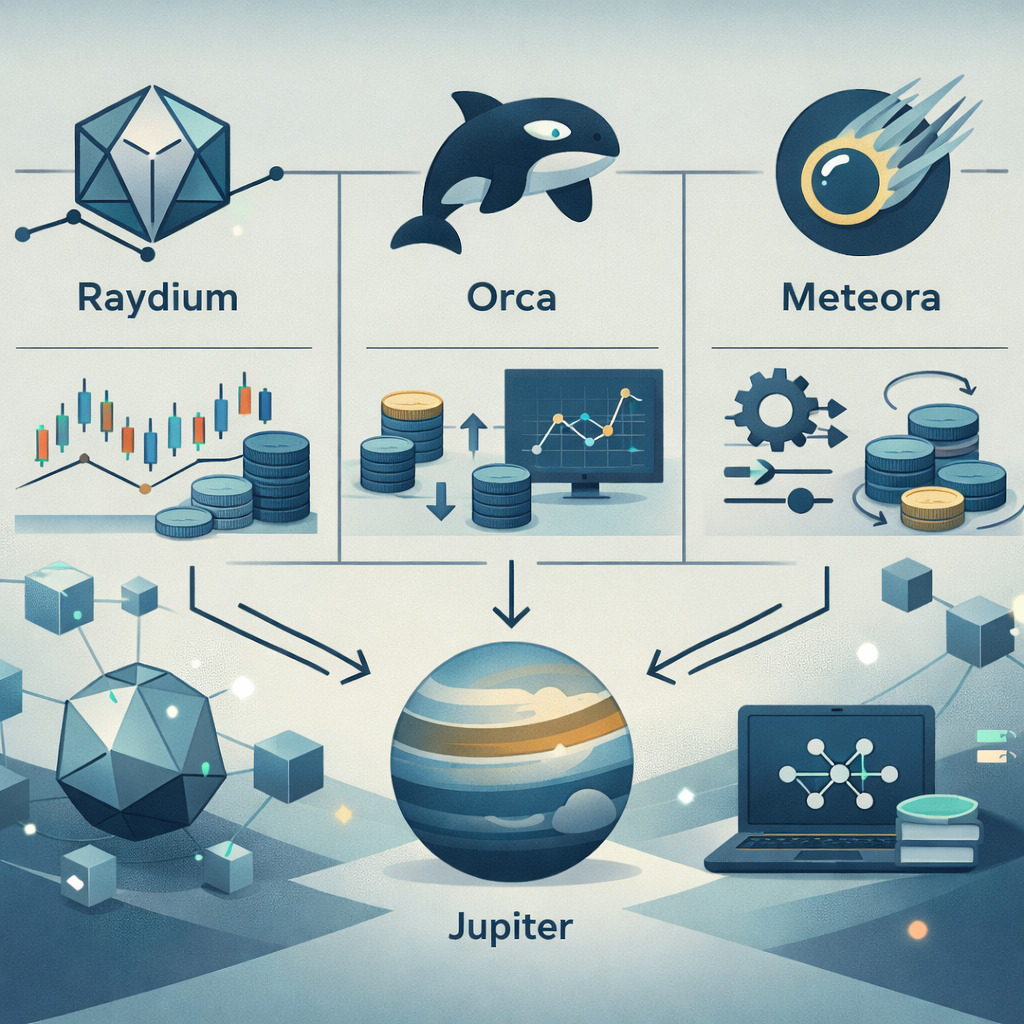
Raydium is like the main street of Solana trading.
When most people think “Solana DEX pool,” they’re picturing Raydium-style liquidity. That matters because visibility and routing tend to follow the crowd.
Raydium docs (authority link): https://docs.raydium.io/
When Raydium is your best bet
Pick Raydium if:
- You’re launching and need maximum compatibility with aggregators and traders.
- Your liquidity is decent (even $20k–$100k can be workable depending on goals).
- You want to optimize for rank/list momentum rather than micro-optimizing execution.
A realistic Raydium volume plan (numbers that won’t embarrass you)
If your pool has around $50k in liquidity, a common mistake is trying to force $500k/day in volume immediately.
That’s how you create:
- obvious churn patterns
- sudden candles that look manufactured
- price snapping back violently
A more believable ramp might look like:
- Day 1: $30k–$80k volume
- Day 2: $80k–$200k volume
- Day 3: $200k–$400k volume
You’re not trying to “fake a moon.” You’re trying to create a chart that looks like real discovery.
If you want deeper tactical ideas, this is worth a read: Volume Bot Tips & Best Practices.
Raydium’s biggest trap: thin liquidity + aggressive sizing
On thin pools, the bot becomes the market.
That’s not market making—that’s self-inflicted volatility.
If your trades move price more than 0.30%–0.80% per swap (ballpark), you’re not “boosting volume.” You’re hammering your own chart.
Use smaller trade sizes and longer time windows, or consider concentrated liquidity (Orca/Meteora) to reduce price drift.
Orca Whirlpools: tighter control (with a real trade-off)
Orca Whirlpools (concentrated liquidity) is like placing your liquidity “where the action is,” instead of spreading it across infinity.
That’s powerful because it can reduce slippage near current price and make trades look smoother.
But it’s also less forgiving.
When Whirlpools shines
Orca is strong if:
- your token’s price is relatively stable (or you’re actively managing it)
- you want lower price impact for a given trade size
- you’re aiming for a more “professional” trading surface
The trade-off: range management
Concentrated liquidity means you’re betting the price stays within a band.
If the price drifts outside your active range, liquidity becomes less effective—and suddenly your “smooth” plan becomes a mess.
If you don’t want active management, Raydium can be simpler.
Meteora DLMM: dynamic bins for chaotic markets
Meteora’s DLMM approach is popular because it’s built for markets that move.
Instead of one continuous range, liquidity is organized in bins, which can make execution behave more predictably during volatility.
When DLMM is the right tool
Meteora can be a great fit if:
- you have a volatile token (launch phase, meme phase, news-driven)
- you want smoother fills without constantly re-anchoring a range
- your goal is to maintain chart quality while building activity
The trap: “DLMM will fix everything”
It won’t.
If your pool is thin, or your trades are oversized, DLMM just gives you a nicer-looking way to create the same problem.
The real unlock is matching:
- trade size
- frequency
- fee tier
- liquidity placement
…to your liquidity reality.
Jupiter: the router that makes execution feel smarter
Jupiter isn’t a DEX pool. It’s a route optimizer.
That means it can split or route orders across venues to reduce slippage and find better pricing.
Jupiter docs (authority link): https://docs.jup.ag/
When routing helps your volume strategy
Jupiter is useful when:
- you want more consistent execution across fragmented liquidity
- the “best pool” changes throughout the day
- you’re optimizing for cleaner average fills
But remember: your trades still land in real pools. If the underlying liquidity is bad, routing can’t perform miracles.
How to choose the right DEX in 5 minutes (a practical checklist)
If you only do one thing after reading this article, do this.
1) Look at liquidity depth, not just TVL
Two pools can both show $100k liquidity.
But one might be distributed well near the current price, while the other is effectively unusable.
What you want is depth near mid-price, so your bot isn’t punting the chart every trade.
2) Match your strategy to your goal
Ask yourself what you actually want:
- Trend faster on trackers? You care about believable cadence and distribution.
- Support price stability? You care about minimizing price impact.
- Attract real traders? You care about execution quality and spread.
Your goal determines your DEX choice.
If trending is your main objective, you’ll probably also want to review tools like DexScreener reactions and rank mechanics. Relevant feature pages:
- DexScreener Trending Bot: /dexscreener-trending-bot
- DexScreener Reactions: /features/dexscreener-reactions
- Solana Rank Bot: /features/solana-rank-bot
3) Check fee tiers and how they affect churn
Higher fees can reduce “spammy” micro-trading because the cost adds up.
Lower fees make it easier to run frequent, smaller trades—but can also look more bot-like if you overdo it.
A believable pattern usually mixes:
- varied trade sizes
- varied timing
- occasional pauses
4) Budget based on reality (not Twitter fantasies)
Here’s a grounded budgeting frame:
- For micro-caps, a steady $50–$200/day can outperform a chaotic $1,000 blast.
- For stronger liquidity, you can scale to $300–$1,500/day with better stability.
If you want a quick estimate, use the Volume Calculator: /calculator
And if you’re comparing plans, keep it simple:
- Pricing: /pricing
- All features: /features
5) Decide your “home pool,” then let routing be a bonus
A lot of teams try to route everywhere from day one.
That’s like trying to open four stores before you have one profitable location.
Pick one primary pool where your volume story will live (often Raydium), then consider routing once you’ve proven stability.
Real-world setups (so you can copy what works)
Let’s talk in concrete playbooks.
Setup A: New token, modest liquidity, want clean growth
Best fit: Raydium (primary)
Why: You want maximum visibility and the simplest execution environment.
How it typically looks (safe-ish defaults):
- smaller trades (avoid repetitive identical sizes)
- longer runtime (think hours/days, not minutes)
- steady cadence with natural breaks
What you’re optimizing: chart readability and consistent activity.
Setup B: Volatile token, trying to reduce chart chaos
Best fit: Meteora DLMM or Orca Whirlpools
Why: Concentrated/dynamic liquidity can reduce slippage near current price.
How it typically looks:
- tighter trade size limits
- monitoring active range/bins
- adjusting when volatility expands
What you’re optimizing: smoother execution and reduced price whipsaws.
Setup C: You already have real flow, want better execution
Best fit: Jupiter routing on top of solid pools
Why: Routing can reduce slippage and improve consistency.
What you’re optimizing: efficiency, not optics.
“Volume bot vs manual trading” (why DEX choice matters more than you think)
Manual trading can work when:
- you’re only doing a few entries a day
- you’re reacting to news
- you’re supporting liquidity occasionally
But if your goal is consistent market presence (dozens to hundreds of trades/day), humans get sloppy.
That’s where automation becomes less about “cheating” and more about repeatability.
If you’re weighing the trade-offs, this breakdown helps: Volume Bot vs Manual Trading.
And if you want the broader Solana context, start here: how a Solana volume bot works.
The two mistakes that blow up most campaigns
Mistake #1: Forcing volume into a pool that can’t handle it
If your pool can’t absorb your trade sizes, you get:
- jagged candles
- obvious wash patterns
- rapid price decay after you stop
A good rule of thumb: if your average trade causes visible price jumps, you’re too big for the pool.
Mistake #2: Optimizing for “screenshots,” not sustainability
A single hour of huge volume might get you a screenshot.
But sustainable ranking and discovery usually come from multi-day consistency.
Think like a store opening, not a fireworks show.
Using volume bot tools (the workflow that keeps you sane)
Once your DEX/pool choice is clear, your workflow should feel boring—in a good way.
Here’s what “boring and effective” looks like:
- Plan your budget with /calculator
- Choose the right feature set via /features
- Monitor execution and adjust in /dashboard
- Keep your plan aligned with your goals (trending, ranking, liquidity support)
Useful pages:
- Main hub: /
- Features overview: /features
- Dashboard: /dashboard
- How to use: /how-to-use
If you’re working with a team, referrals can also help you offset costs as you scale: /referrals
A quick note on safety and staying out of trouble
I’m going to say this plainly: don’t be reckless.
You should understand your local rules, exchange policies, and platform terms. And you should prioritize security basics (separate wallets, limited permissions, clean opsec).
If you want the “do this, not that” security checklist, it’s worth reading: Volume Bot Tips & Best Practices.
For Solana fundamentals, the official docs are here: https://solana.com/docs
So… what’s the best Solana DEX for volume bots in 2026?
If you want one answer:
- Raydium is still the best default for most projects because it’s simple, widely recognized, and integrates smoothly into the broader Solana trading flow.
If you want the better answer:
- The “best DEX” is the one that matches your liquidity reality and your goal.
If your number one pain is price impact, concentrated/dynamic liquidity (Orca/Meteora) can be a real upgrade. If your pain is fragmented liquidity, Jupiter routing helps.
But if your plan is to brute-force volume into a thin pool… no DEX choice will save you.
Related Reading (recommended next)
Ready to pick your DEX and run a clean plan?
If you want to stop guessing and build a volume strategy that actually matches your pool and budget:
- Start with the Volume Calculator: /calculator
- Compare options on Pricing: /pricing
- Explore what you can automate on Features: /features
- Then launch and monitor in your Dashboard: /dashboard
If you want help choosing the right setup for your token’s liquidity and goals, reach out here: /contact
Written by
Ready to Boost Your Token?
Join thousands of successful projects using our advanced Solana Volume Bot platform. Increase your token's visibility, attract investors, and dominate the trending charts.
More from Solana Volume Bot
Jupiter Volume Bot Strategy for Solana: Real 2026 Guide
A practical Jupiter volume strategy that looks organic: pacing, trade sizes, wallet setup, and what to monitor so you don’t trip obvious red flags.

Real vs Fake Volume on Solana: Owner’s Playbook
Struggling to tell if Solana token volume is real or botted? Learn how to spot fake volume, avoid getting flagged, and use volume bots safely and profitably.